Incision & Drainage of Abscess
General Surgery · MRCS Part A & B · Core Trainee
Operative Simulator
Worked example: drainage of an axillary abscess. Tick every item on each checklist to unlock the next step.
Operative Guide
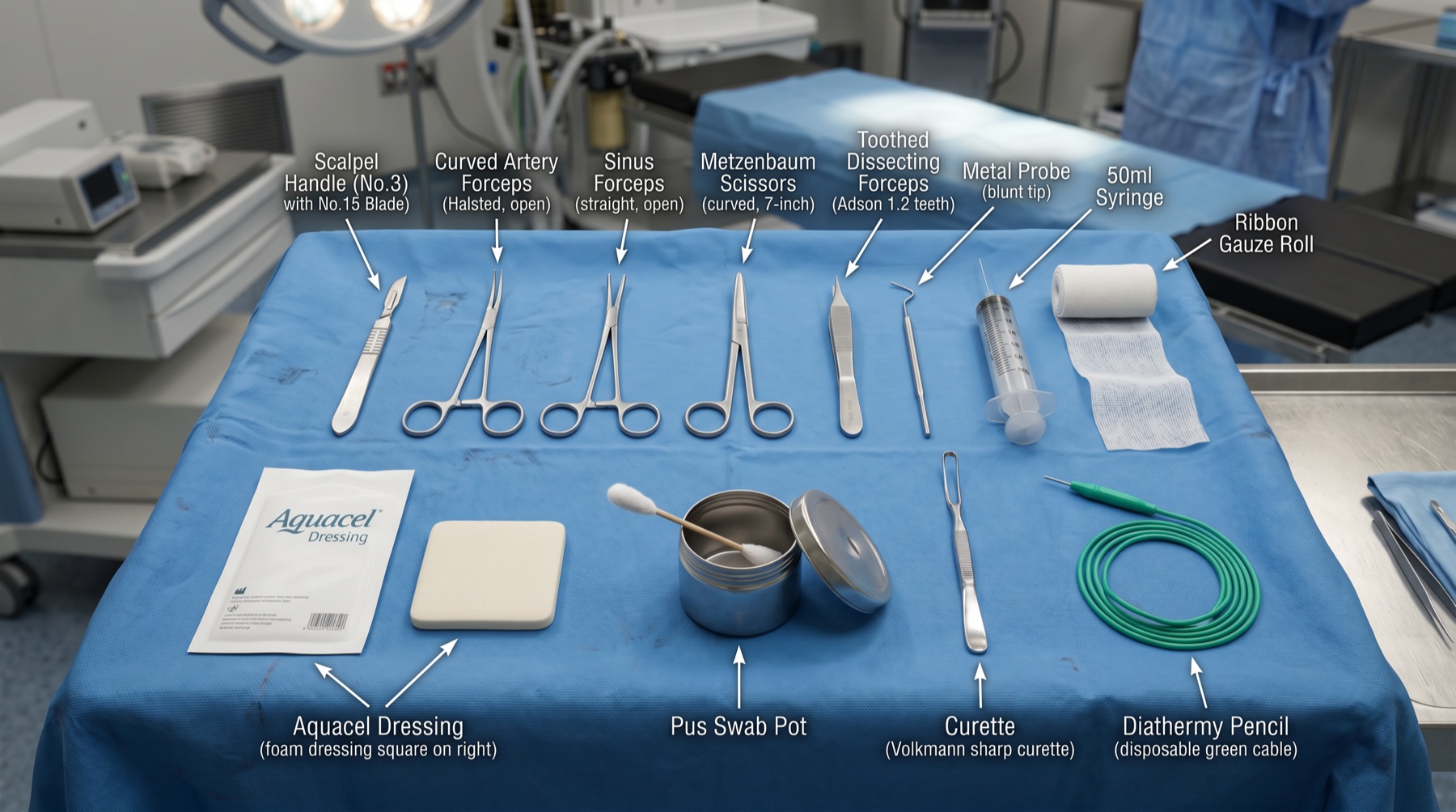
Instruments
Anatomy Danger Zones
Brachial plexus & axillary vessels
Lie deep to an axillary abscess. At risk with blind deep dissection beyond the cavity walls, stay within the abscess cavity during deloculation and never probe beyond the walls.
External anal sphincter
Voluntary striated muscle surrounding the anal canal. Fistulotomy risks dividing the sphincter and causing permanent faecal incontinence, never perform fistulotomy at first presentation; place a loose seton and refer to colorectal.
Intercostobrachial nerve
Crosses the axilla and provides sensation to the upper inner arm. At risk during dissection of an axillary abscess, stay within the cavity and avoid wide lateral dissection.
Vas deferens & testicular vessels (perianal/scrotal)
At risk in large ischiorectal or scrotal abscesses; Fournier’s gangrene can involve scrotal structures. If there is crepitus or spreading necrosis, this is Fournier’s, not a simple abscess, escalate immediately.
Complications
Early
- •Incomplete drainage, the most common error (incision too small, loculations missed)
- •Wound infection / cellulitis
- •Bleeding
- •Recurrence from premature skin closure
- •Faecal incontinence if fistulotomy performed inappropriately (perianal)
- •Fournier’s gangrene, rare, life-threatening; return to theatre immediately if suspected
Late
- •Fistula-in-ano, up to 50% after a perianal abscess
- •Chronic pilonidal sinus requiring definitive excision
- •Hidradenitis suppurativa progression (axillary I&D is temporising only)
- •Scarring and chronic wound
- •Recurrent abscess, especially in diabetics, immunocompromised, or Crohn’s
MCQ Quiz
You perform I&D of a perianal abscess and identify a clear fistula tract during probing. What should you do?
What is the most common technical error when draining an abscess?
A 45-year-old man with poorly controlled type 2 diabetes presents with a perianal abscess. Which investigation is most important pre-operatively?
A patient returns 48 hours after perianal I&D with worsening perineal pain, scrotal swelling, and crepitus on examination. What is the diagnosis?
Which position is used for pilonidal abscess drainage?
Post-op Care
Immediate
- ›Regular paracetamol + ibuprofen
- ›Leave packing in situ, do not disturb for 24–48 hours
- ›Arrange dressing changes before discharge (district nurse, GP practice nurse, or stoma nurse for complex wounds)
Discharge
- ›Most patients same day
- ›Discharge with wound care instructions
- ›Laxatives if perianal (to soften stool)
- ›Antibiotics ONLY if systemically unwell / diabetic / immunocompromised / facial or hand abscess (co-amoxiclav 5 days)
- ›Safety-net: return immediately if fever + worsening pain + crepitus (Fournier’s), spreading redness, or inability to open bowels
Follow-up
- ›Wound check 1–2 weeks
- ›Pilonidal, review at 6 weeks; hair removal advice; consider referral for definitive excision if recurrent
- ›Perianal, colorectal outpatient follow-up if a fistula was identified
- ›Histology review for all specimens
Sick note
- ›Office work 1–2 weeks
- ›Manual labour 2–4 weeks
- ›Perianal wounds may take 6–8 weeks to fully heal with dressing changes throughout